If your Monstera is blocking a doorway or brushing the ceiling, start by identifying the space problem, not by cutting off the nearest leaf.
A sprawling vine, a tall climber, and a plant whose leaves are simply too wide need different decisions. A support can organize growth, but it does not turn a large plant into a permanently compact one. The Royal Horticultural Society describes both support and pruning as ways to manage these vigorous climbers.
This guide is for Monstera deliciosa, the large-leaved Swiss cheese plant. Confirm the plant's identity before using pruning instructions; a common name or a similar leaf shape is not enough.
First, decide what “too big” means
Measure the plant's height, its widest spread, and the available space. Include the pot, support, and any raised stand. Then choose the closest description:
| What you see | First option to assess | What that option will not solve |
|---|---|---|
| The main stem sprawls sideways, with usable space above | A stable support and gentle training | It will not shrink existing leaves or stop future growth. |
| The plant is upright and has reached the ceiling | Removing an unnecessary stand, relocating, or planning stem pruning | A taller pole does not create more ceiling clearance. |
| Large leaves block the room even when the stem is supported | A roomier suitable location, selective reduction, or rehoming | Tying leaf stalks together is not a substitute for enough space. |
| The pot or support tips or shifts | Stabilization and help handling the plant | Pruning alone does not establish a secure base. |
These are planning choices, not a diagnosis from size alone. If the plant is also declining, investigate that separately before undertaking an elective reshaping project.
Photograph the whole plant and its support before making changes. Write a specific aim: “clear the walkway” or “bring the top below the ceiling,” rather than “make it smaller.”
If the problem is sprawl, assess the support
Monstera deliciosa is a climbing vine that uses aerial roots to attach to supports. University of Wisconsin–Madison describes its climbing habit and the need for a strong support in containers.
A substantial pole, bark-covered support, or suitable trellis may be more useful than a thin stake. Choose something that fits the plant's present size and the room's limits; there is no need to buy a taller pole when height is already the problem.
Trace the main vine before attaching it. Support the stem, leaving individual leaf stalks and emerging growth free. Use soft ties without constricting the stem, and check them during later care rounds. Do not force a rigid, mature vine upright in one attempt or push a support blindly through a crowded root ball. Ask an experienced grower for help when installing it would require major handling or repotting.
A moss pole is one option, not an automatic size-control device. RHS notes that climbing support can encourage larger, more mature leaves. That may be welcome for a display plant but does not resolve every small-room problem. See the RHS training guidance.
If the problem is height, plan pruning before cutting
First check whether the container is elevated unnecessarily. Lowering a plant stand can create clearance without removing plant material, provided the new position is stable and still has suitable light.
When stem reduction is needed, North Carolina Extension recommends spring pruning. Choose a time when you can monitor the plant afterward. A tipping plant needs prompt stabilization, regardless of season.
Know which part you are cutting
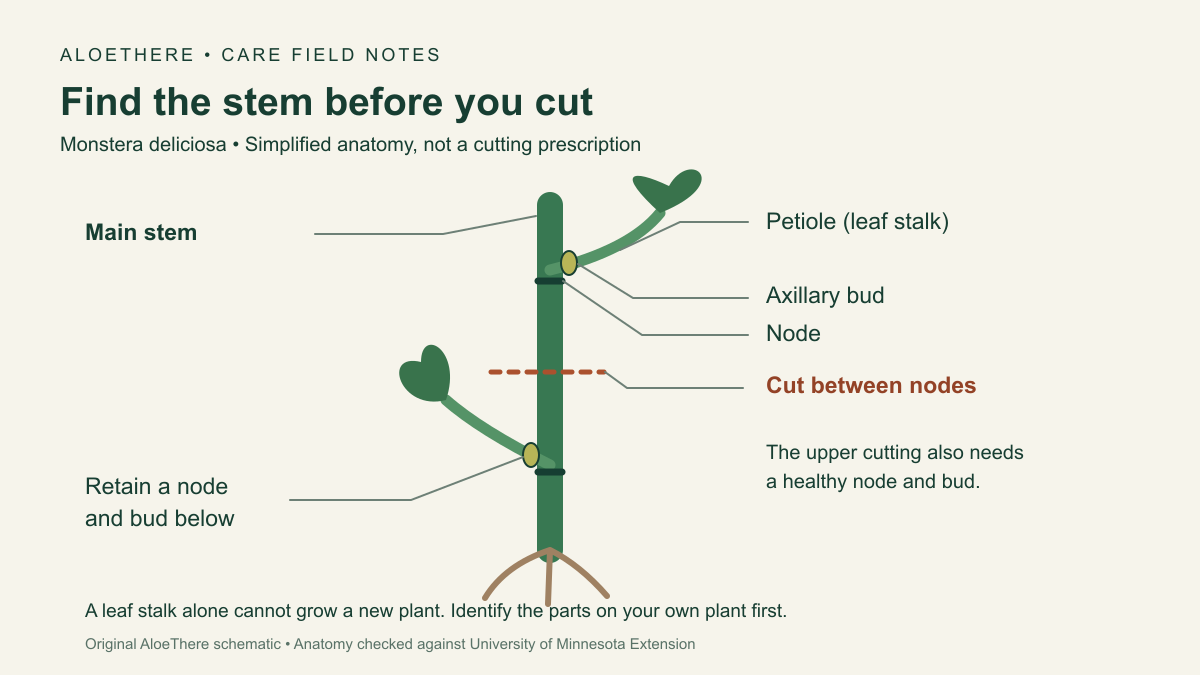
The main stem carries successive leaves and growth points. A petiole is the stalk of one leaf. A node is its attachment point on the stem; an axillary bud near it can produce new growth.
Removing a leaf stalk is not the same as shortening the main vine. A leaf and its stalk, without a stem node and bud, cannot produce a new Monstera plant. University of Minnesota Extension explains this distinction in its propagation guide.
Choose the cut and the destination for the cutting
The diagram above is a simplified orientation guide, not a prescription for your plant. Open the full-size stem diagram to inspect the labels. Locate the actual nodes and buds before choosing any cut.
Choose a cut between nodes, keeping healthy leaves and a node on the rooted section. To propagate the upper section, preserve a healthy node with an axillary bud on it too. Minnesota describes cutting below the node retained on a cutting. Do not cut through the node itself.
Support the upper section before cutting so its weight does not tear the remaining stem. For a heavy or tangled specimen, get help before starting. Avoid cutting more than the space problem requires simply to make the plant look symmetrical.
Use a sharp tool suited to the stem. Remove debris and disinfect the blades before use and between plants, following the disinfectant's directions. Minnesota Extension explains tool cleaning and disinfection.
Wear gloves when handling cut material: North Carolina Extension identifies the sap as a skin irritant. The ASPCA lists Monstera deliciosa as toxic to cats and dogs because of insoluble calcium oxalates. Keep the plant, cuttings, and debris away from children and pets. Contact a veterinarian promptly if a pet may have eaten it.
Have a stable rooting container ready. Minnesota describes rooting in water or a moist, well-drained medium, with support for top-heavy cuttings. Follow its method for your chosen setup. Rooting is not guaranteed, and a new plant also needs somewhere to live.
What about the aerial roots?
Long aerial roots are part of this plant's climbing habit, not proof that it needs a larger pot. Where they reach naturally, you can guide them toward an appropriate support or the potting mix; Wisconsin describes their ability to attach to supports and root on contact with the ground. Do not force a stiff root into a sharp bend. Read Wisconsin's Monstera profile.
Trimming aerial roots does not shorten the main vine. Treat roots catching on furniture as a placement or training issue before turning root removal into a routine job.
A different location, or a new home, may fit better
Before pruning, compare the alternatives. Is there another suitable position where the plant's current shape works? Would moving a small piece of furniture solve the conflict? Can you actually get the plant through the doorway without damaging it?
A new spot still needs appropriate growing conditions. Avoid moving an indoor-acclimated Monstera abruptly into strong direct sun; Wisconsin warns that an outdoor move requires gradual light acclimation. Its care guide covers this transition.
A bigger pot is not a remedy for a plant that is already too big for the room. Assess root space and drainage separately. RHS cautions against a much larger container because the extra mix can remain wet too long. See its potting guidance.
Rehoming is a legitimate choice when the plant's size no longer suits your home. Give the recipient its measurements, care history, and any known pest concerns. Keeping one suitable cutting is optional; keeping every cutting would work against the original goal of reclaiming space.
Record the change before judging the result
Take a photo immediately after the work to document the new arrangement. Use later photos from similar angles and lighting to compare growth and damage, not to claim a recovery simply because the plant looks tidier.
Date and plant location:
Before: height / widest spread / clearance:
Problem I am trying to solve:
Change made:
Stem sections removed or cuttings retained, if any:
After: height / widest spread / clearance:
Support stable? Ties clear of new growth?
Moisture and visible condition:
Next check and what to look for:
Photo references:
Continue checking moisture rather than automatically keeping the old watering interval. The soil-first watering guide explains the check, and our weekly care routine provides an ongoing log.
RHS notes that new stems after pruning may initially carry smaller, less mature leaves. Compare actual growth rather than expecting a particular leaf by a deadline. If decline continues or the cut area becomes soft, collect clear problem photos and care context and ask a local horticultural adviser for help.
AloeThere Plant Health can keep plant profiles, photos, and health-check history together for later comparison. It is free to download with in-app purchases; photo guidance can be wrong and does not replace an in-person assessment of a large, unstable plant.
The useful result is a plant you can accommodate and care for, not the largest Monstera you can squeeze into the room.