Free shipping on orders over $49
AloeThere
Login
Back to blog

Plant care field guide

September 29, 20266 min readBy AloeThere

Grow Lights That Fit Your Living Room: Placement, Lamps, and Setup

A practical guide to decorative grow-light setups, with a lamp-compatibility checklist and a worksheet for planning the light at leaf level.

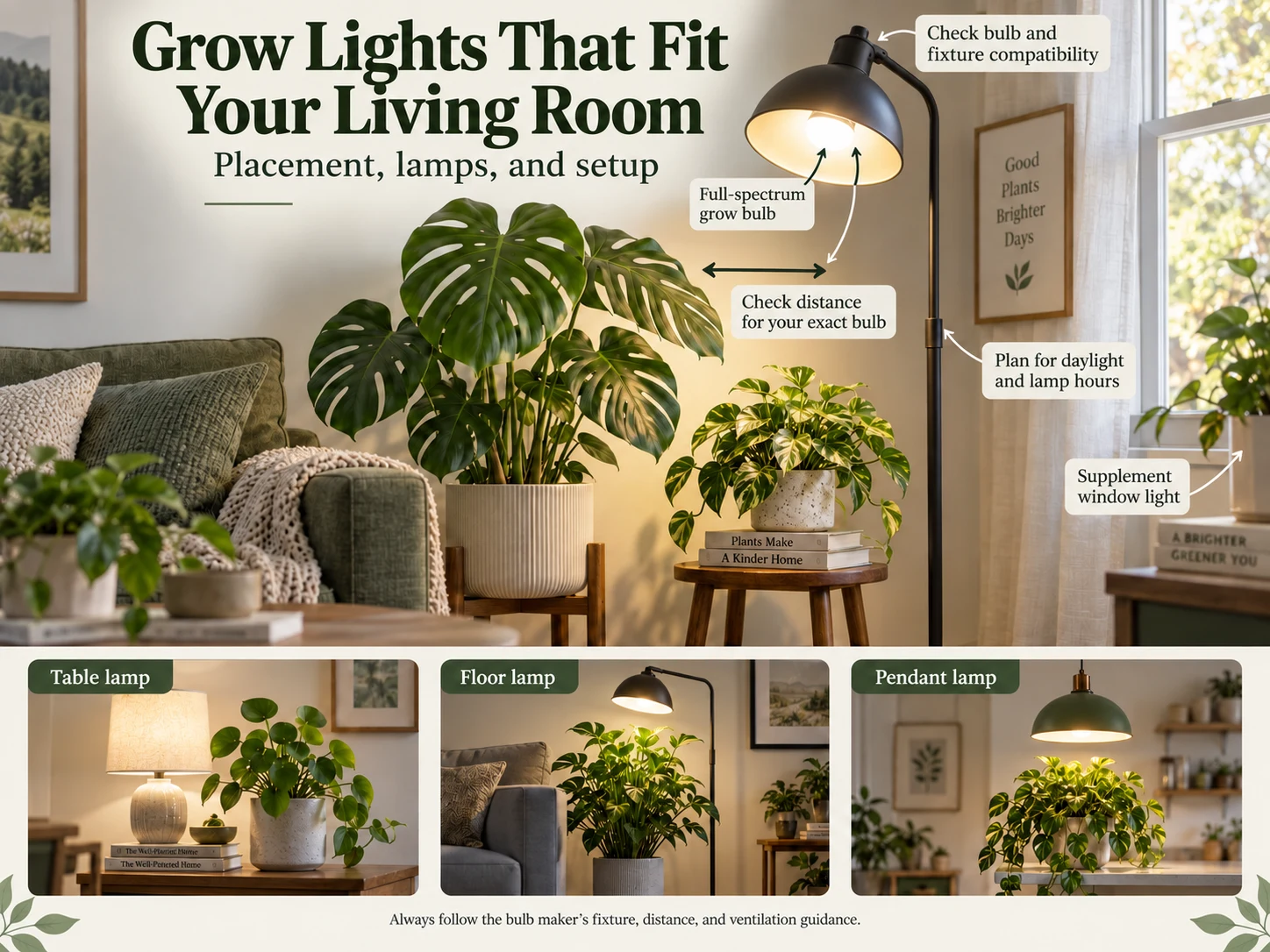
Illustrated living-room grow-light setups with reminders to check fixture compatibility, model-specific distance, and daylight contribution.

A living-room grow-light setup needs to pass two separate checks: the bulb and fixture must be compatible, and the arrangement must deliver suitable light to the plant. A bulb that screws into a lamp has not automatically passed both. Start with the plant’s position, then choose a fixture you like that can light that position safely.

You do not need purple lighting to grow houseplants. White-light options exist; GE’s grow-light range includes spectra that appear white to the eye. Appearance is one selection criterion, not proof that a particular setup supplies enough light.

Choose the arrangement before the bulb

Sketch where the leaves will be, where you sit, and where the power outlet is. Then choose an arrangement that does not depend on hiding the light behind furniture or moving the plant every evening.

These are layout options to evaluate, not tested product combinations:

Your situationAn arrangement to considerThe deciding question
One plant on a side tableAn adjustable task lamp with a compatible grow bulbCan the lamp aim at the foliage without shining into your usual seat?
Several small plants on one shelfA purpose-made plant-light bar mounted as instructedWill the whole planted area sit beneath the illuminated area, rather than behind the shelf’s front edge?
A tall floor plantA directional floor lamp or properly installed pendantCan you light the canopy without an unstable stand or a cord across a walkway?
Plants spread around the roomMore than one local light, or a smaller groupingAre you trying to make one distant bulb serve unrelated positions?

A good starting project is one plant or one shelf. Decide what that setup needs before trying to redesign the whole room.

Can you put a grow light in a regular lamp?

Sometimes. Check the instructions for both the exact bulb and the exact fixture, not just a listing that says “standard socket.”

For example, Soltech’s Vita specifications identify the base, voltage, dimensions, weight, power consumption, and dimming capability. SANSI’s BR30 36W guidance specifically advises against tightly closed fixtures for ventilation and heat dissipation. Requirements differ; neither example approves an arbitrary lamp you already own.

Before combining a lamp and bulb, resolve these questions:

Compatibility checkWhat to confirm in the manufacturers’ information
Electrical fitThe bulb’s base and operating voltage match the fixture and local supply.
Power ratingThe actual electrical draw is within the fixture’s rating for that bulb type. Do not substitute an “equivalent wattage” marketing number.
Physical fitThe bulb’s dimensions, weight, and required clearances suit the shade, socket, and adjustable joints.
Heat and enclosureThe bulb is approved for the proposed enclosure, with all required ventilation and clearance maintained.
ControlsA dimmer, touch control, timer, or smart plug is compatible with the equipment.
InstallationThe intended position and mounting method follow the fixture instructions.

If either set of instructions is missing or contradictory, ask the manufacturer before using that combination. Do not modify a shade, cover ventilation openings, or improvise socket adapters to force a fit.
Keep the shade’s job separate from the plant’s needs

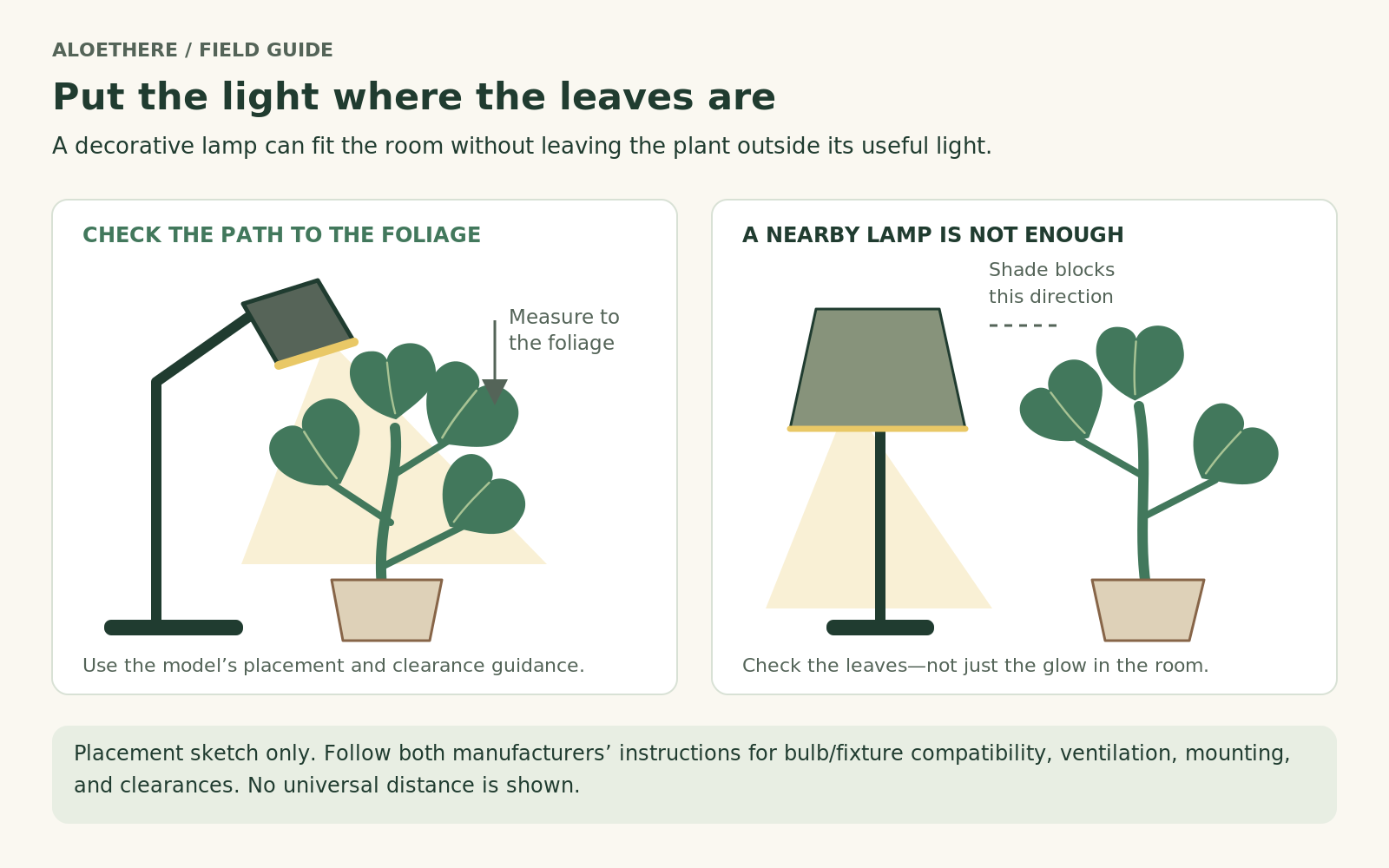
A shade can make a lamp more comfortable to live beside. It can also sit between the bulb and the plant. Look at the actual opening and direction of the fixture rather than judging the setup from the opposite side of the room.

With an opaque shade, ask: does the plant sit in the light leaving the opening, or beside the covered part? With a shelf light, ask: are the leaves underneath it, or behind a solid lip? A pleasing glow on the wall is not evidence about the leaves.

Do not solve glare by wrapping the bulb, adding an unapproved cover, or packing it into a smaller enclosure. Choose another approved fixture or change the layout. Conceal distracting hardware where practical while preserving the light path and ventilation.

Conceptual lamp layouts comparing light directed toward foliage with a plant outside the main beam beside an opaque lampshade.

View the diagram at full size.

How far should a grow light be from the leaves?

Use the manufacturer’s guidance for the exact model, beam angle, and plant-light requirement. Measure to the foliage, not the floor, pot rim, or soil surface.

University of Minnesota Extension explains that distance changes the light reaching plants and that electrical wattage is not a measurement of delivered light. Where available, look for PPFD information: the rate at which photosynthetically active photons reach an area of the plant. A measurement at one position does not describe an entire shelf. Read Minnesota’s indoor-lighting guide.

Ask the manufacturer which recommended distance applies to your plant and how large an area it covers. “Grow light” on the box is not enough information to choose a universal height.

For a broad canopy, record the nearest leaves and the outer leaves separately. The practical question is not just whether the middle looks bright, but whether the intended growing area is covered. Recheck the arrangement when the plant grows toward the fixture.

How many hours should it run?

Minnesota Extension gives 12–14 hours of light per day for foliage plants as a general guide. Treat that as a starting point for many foliage houseplants, not a universal rule for seedlings, flowering plants, or every species. Intensity and duration both matter. See its duration guidance.

Plan around the plant’s whole lighted day. Do not automatically add 14 lamp hours after a full day at a window, or leave the lamp running continuously. Lamp hours overlapping daylight are still the same clock hours, although both sources contribute light.

A compatible timer can make the arrangement repeatable. Write down its on/off times and check that the equipment resumes as expected after a power interruption. Do not use a longer schedule as a substitute for checking a poorly aimed or unsuitable light.

When you are supplementing a window

Describe the window contribution separately: when direct sun reaches the leaves, what blocks daylight, and whether curtains normally stay open. Our bright-indirect-light room check helps with that assessment.

For example, “window plus lamp over the left side of the shelf” is a useful starting description. It tells you which part to inspect next. “Bright living room” does not.

Revisit watering observations after a meaningful change in lighting. Light is one factor affecting water use; a new lamp is not an instruction to water more automatically. Maryland Extension explains the factors behind watering needs. Use the indoor watering guide to keep the decision condition-based.

Save a setup card

Use this original planning worksheet for one arrangement. It records decisions; it does not measure light or certify electrical compatibility.

Setup fieldYour notes
Plant and exact location
Bulb and fixture model; instructions checked
Distance to nearest and outer leaves
Window contribution and obstructions
Lamp on/off times
Baseline photo date
Next observation or unresolved question

Take a baseline photograph using the plant-problem photo checklist. Compare the same plant and location later rather than relying on how the room feels at night.

The best-looking setup is one you can leave in place because it works for both the room and the plant. Start small, verify compatibility, and check the light at the leaves.