Free shipping on orders over $49
AloeThere
Login
Back to blog

Plant care field guide

October 7, 20265 min readBy AloeThere

Monstera Aerial Roots: What to Do With Them

Long roots are normal on a climbing Monstera. Decide which to leave, which to guide, and when to check the roots inside the pot.

Monstera care decision guide: leave roots with space, guide flexible roots toward support, and assess the root ball separately before repotting

A thick root is creeping over your Monstera's pot. Another is heading toward the floor. Leave aerial roots that have room, gently guide those that are in the way, and assess the roots inside the container before deciding to repot. Their length alone does not call for a bigger planter.

This guide concerns Monstera deliciosa, the large-leaved climbing houseplant. Its aerial roots grow from the stem and help it attach to supports. In the wild, some grow down to the ground and root there. A root extending beyond the pot is part of that growth habit. University of Wisconsin–Madison Extension explains how Monstera climbs.
Choose a next step for the root in front of you

Look at where the root starts and where it is heading. Then use the closest situation below.

On a smaller screen, swipe or scroll the table sideways to see every column.

What you seeA useful next stepCheck before acting
A root hangs freely without obstructing anythingLeave it and include it in routine inspectionsIs there space for it as you move or water the plant?
A flexible root naturally curves toward the potGently guide its tip toward the mixCan it reach without pulling the stem or making a sharp bend?
Roots and the main vine are spreading sidewaysAssess a stable climbing supportWill the support fit securely and leave access for watering?
A rigid root catches on furnitureAdjust the plant's position or the obstacle firstCan you clear the snag without forcing the root?
The plant also dries unusually fast or has a crowded root ballAssess the container and root system separatelyWhat is happening inside the pot?

The illustration above summarizes these choices. It is a care schematic, not a photograph of root disease. Open the full-size guide if you want to keep it beside the plant while checking.

Give the main stem a stable support

A Monstera carrying heavy leaves needs a support appropriate to its size. A moss-covered pole is one option: the roots can grow into moist moss as the vine climbs. The Royal Horticultural Society recommends supporting and training Monsteras.

Trace the main stem before placing ties. Keep individual leaf stalks and emerging growth free, and allow room for the stem to thicken. Do not try to solve a leaning plant by cinching its leaves into a bundle.

Before installing anything, check three practical details:

  1. The support can stand securely without making the pot tip.
  2. You can position it without blindly driving it through a crowded root ball.
  3. You can still reach the potting mix and remove excess water after watering.

A taller pole will not solve a ceiling-height problem. If the whole plant is outgrowing its location, use the oversized-Monstera guide to compare support, pruning, and moving it.

Can you put Monstera aerial roots into soil?

Yes. A root that reaches growing medium can root into it, consistent with the plant's natural habit described by Wisconsin Extension.

If a root already curves toward the pot, gently bring its tip to the surface. Stop if doing so would require a tight bend, pull the vine sideways, or disturb its support. There is no need to bury the stem or coil every root inside the container.

Think about future handling, too. If the root enters another plant's pot, the two containers may become awkward to move separately. Choose a destination you can maintain rather than simply the nearest patch of soil.

Should you put an aerial root in a glass of water?

It is not a necessary step in the care of a potted Monstera. The established plant still needs an appropriate watering routine for its root ball. A glass beside the pot also gives you another vessel to clean, refill, and move without pulling on the plant.

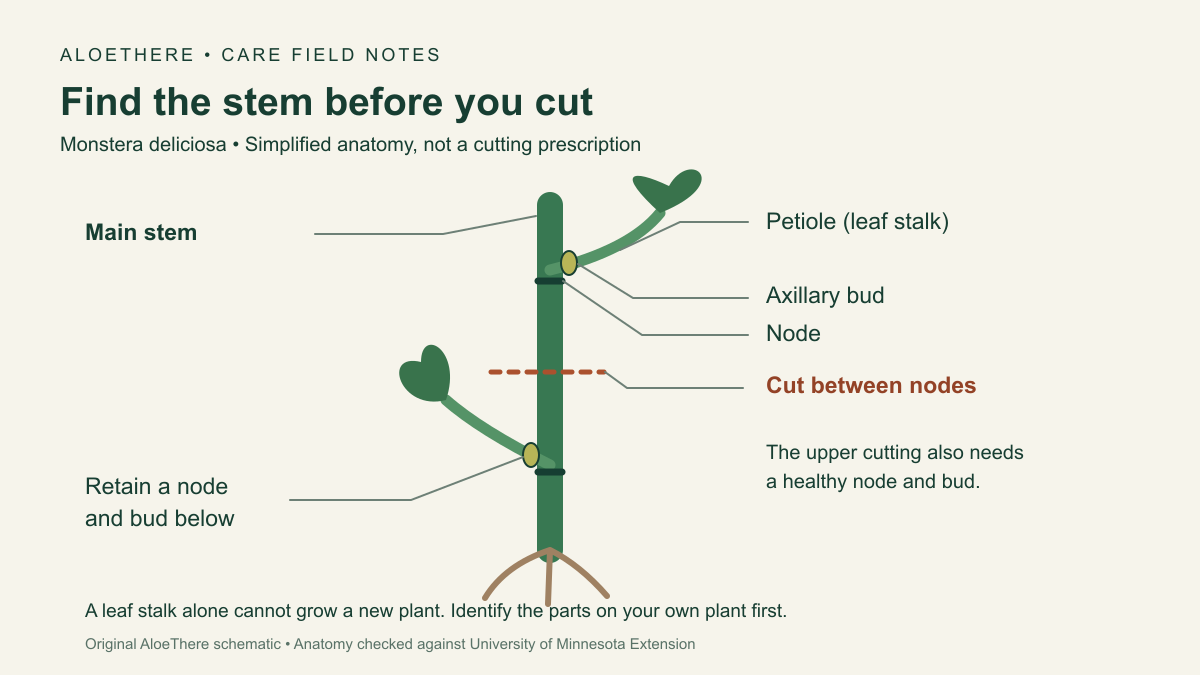
Keep two questions separate: caring for an attached aerial root, and rooting a stem cutting. For propagation, the important starting point is a suitable stem section with a node and growth bud. Minnesota Extension's propagation guide explains that anatomy.

Do you need to cut aerial roots that are too long?

Usually, length alone gives you no reason to remove them. Start with the specific problem: a blocked walkway, a root trapped behind furniture, or a plant that is difficult to move. A change in placement or gentle guidance may solve it.

Before considering a cut, trace the root all the way back to the stem and check whether it is already attached to a support or rooted into growing medium. Do not sever roots blindly to tidy the plant's outline. If you cannot identify the parts, compare them with our labeled stem diagram first.

If pruning is needed for a large or tangled specimen, ask an experienced grower to assess the actual plant. Removing a root will not shorten the main vine or resolve an unstable support.

Do aerial roots mean your Monstera needs repotting?

Check the container separately. Aerial growth tells you about the climbing plant above the soil; it does not show how tightly roots fill the pot.

If there is a reason to inspect the root ball, support the plant while removing the container. Consider crowding, drainage, and how quickly the mix dries. Avoid repotting solely to hide visible roots.

When a larger container is needed, RHS recommends a modest increase in size and freely draining mix. A much larger volume of wet mix can create root problems. Read its potting guidance.

Can an aerial root grow a new Monstera by itself?

An aerial root alone is not a suitable cutting. New shoots develop from a stem's node and axillary bud. A detached leaf stalk without those parts also cannot produce a new plant. Minnesota Extension illustrates what a viable Monstera cutting needs.

Before taking a cutting, identify its stem, node, bud, and leaf stalk. Root length cannot substitute for a growth point.

A quick check to keep

Take a whole-plant photo, then a closer photo of the root causing the problem. Record its destination, any support adjustment, and whether the pot remains stable. At your next care check, look for renewed contact with furniture or ties that need loosening.

For watering decisions, use the soil-first watering guide. Leave a root that has a clear route and a safe place to grow.