Free shipping on orders over $49
AloeThere
Login
Back to blog

Plant care field guide

September 29, 20267 min readBy AloeThere

Multiple Monsteras in One Pot: Should You Separate Them?

A decision guide for a full Monstera pot: identify what is actually growing, evaluate support, and separate only when it serves a clear purpose.

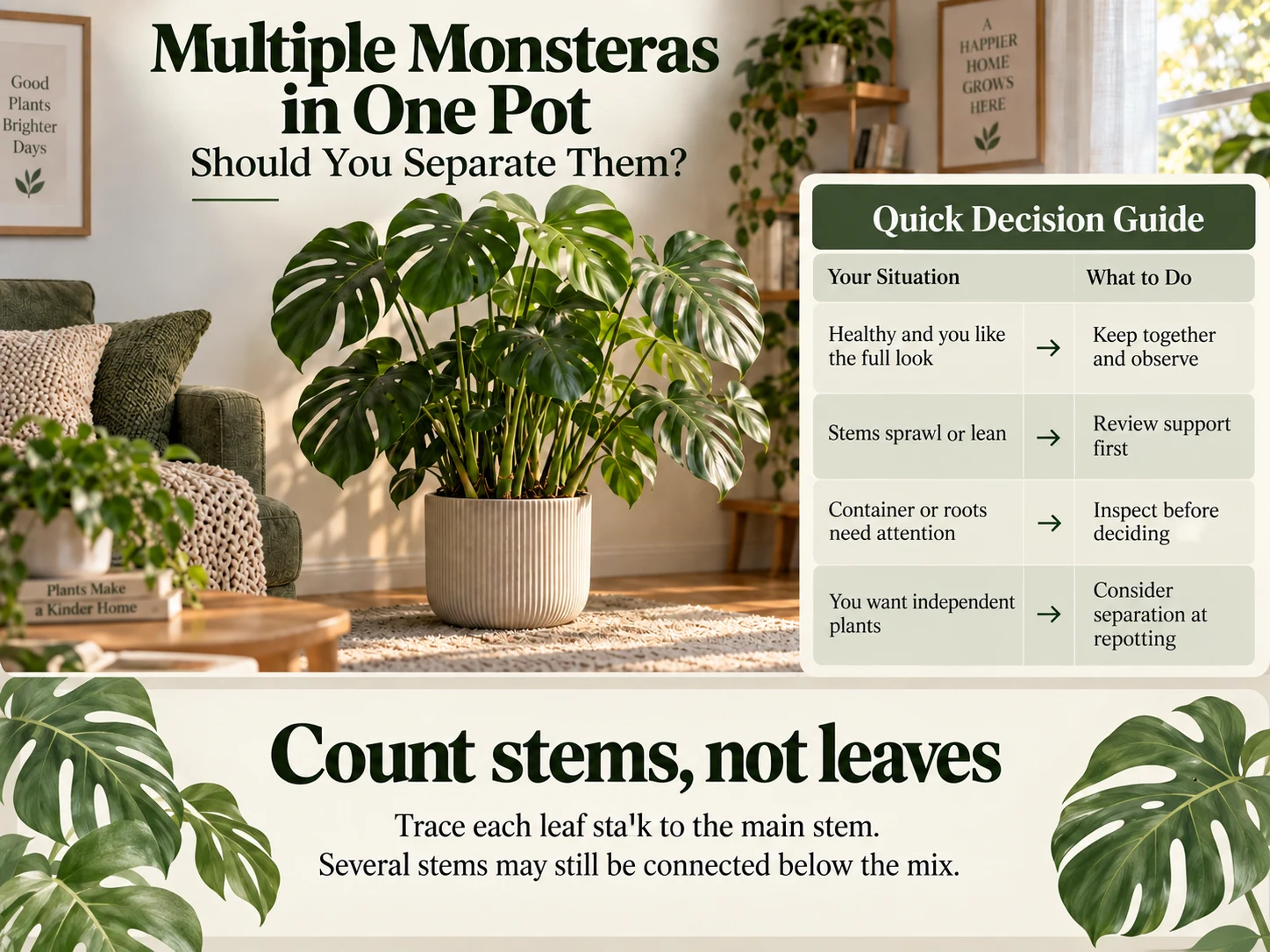
Illustrated Monstera decision guide covering support, root inspection, and keeping plants together or considering separation.

Do not separate a Monstera solely because the pot looks full. First check whether you are seeing several plants or several leaves on one plant, then decide what you need to change: its support, its container, or the number of plants sharing that container.

Our recommendation is to make separation a purposeful choice, not an automatic arrival-day task. If you like the fuller appearance and the planting is manageable, assess support and growing conditions first. For independently positioned plants, consider separation during an appropriate repotting.

This guide concerns Monstera deliciosa, the large climbing houseplant commonly sold with split or perforated leaves. It is a vine, not a cluster of independent plants simply because several leaf stalks are visible. Wisconsin Extension describes its stem, leaves, and aerial roots.
Count stems, not leaves

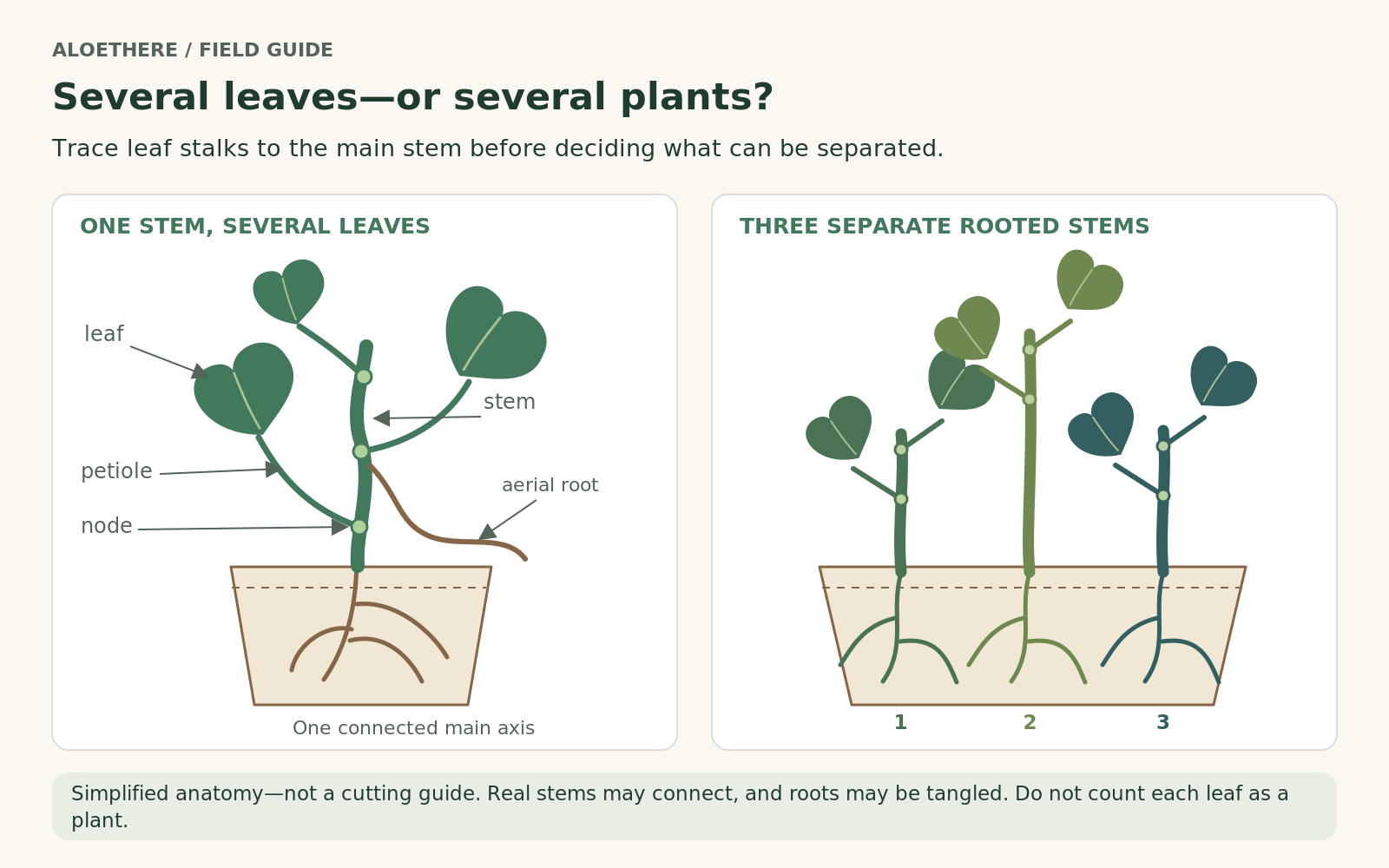
A leaf blade is the broad, flat part. A petiole is the stalk connecting that leaf to the main stem. The main stem continues between successive leaf attachments, called nodes; it is not the same thing as each long green stalk rising above the pot. An aerial root grows from the stem and is not another leafy shoot. Compare Wisconsin’s botanical description with the NC State plant profile.

Start at one leaf and trace its petiole downward with your eyes. Find where it joins the stem. Then see whether neighboring leaves connect to that same stem or to another visible stem.

What you can traceWhat you can reasonably conclude
Several petioles joining one continuous stemSeveral leaves belong to the same stem; they are not several plants.
Several distinct stems entering the mixThe pot may contain multiple plants, but visible stem count alone does not prove they are independent.
A brown, cord-like aerial root emerging above the mixThat is a root, not a separate plant to pull out.
A tightly packed base you cannot see clearlyRecord the count as uncertain; do not dismantle a healthy planting just to get a number.

The “independent” distinction matters: stems can be connected below what you can see. During a justified repotting, check the actual connections before assuming that every visible axis can become a separate rooted plant.

Simplified Monstera anatomy: several petioles on one stem compared with three independent rooted stems sharing a pot; labels identify leaf, petiole, stem, node, and aerial root.

View the diagram at full size.

Choose the outcome you actually want

The following is a decision aid, not a claim that a certain number of Monsteras always succeeds or fails.

Your situationFirst choice to considerWhat would change the decision?
You like the full appearance and care is manageableLeave the planting together and observeA clear support, container, or root-management problem.
The planting sprawls or leans but otherwise seems stableImprove support and review its placementStems cannot be supported sensibly in the existing arrangement.
You want to place or train plants independentlyConsider separation when you can inspect the rootsConnections or tangling make separation more destructive than useful.
The container or mix no longer functions wellAssess repotting without assuming division is necessaryThe root inspection shows a reason to divide as well.
The plant is declining and you suspect a root problemInvestigate the condition rather than focus on plant countFindings that call for specific corrective care.

Two questions help: “What problem will separation solve?” and “Could support or a container change solve it with less disturbance?” If the only answer is that someone online disliked your plant count, pause.

A support problem is not automatically a separation problem

Monstera deliciosa climbs, and large stems need sturdy support. NC State specifically notes support as protection against breakage. Read its care profile.

Look at each main stem’s direction before positioning a support. In a crowded pot, one central pole may be awkward for some of the stems. Consider whether separate supports or a different stable arrangement would let them remain together. Do not force a rigid stem into a sharp bend simply to make everything line up.

If you use ties, identify the main stem first. Support that structure gently rather than gathering the petioles into a tight bundle; leave leaf stalks and emerging growth free. Check that ties are not cutting into the plant and that the support itself is secure. This is an application of the stem-versus-petiole distinction, not a requirement that every Monstera use the same pole.

For the wider room-layout decision, use the guide to a Monstera that has outgrown its space. Separating a planting will not, by itself, create more floor space for the resulting pots.

Keep repotting and separation as different decisions

Repotting changes the container or growing medium. Separation changes which plants share the container. You can choose one without choosing both.

Rapid drying, a top-heavy planting, and deteriorated, poorly draining mix can justify a closer look at the container and roots. They do not establish that multiple plants are the cause. Iowa State Extension discusses these repotting cues.

An aerial root outside the pot is not, by itself, evidence that the below-ground root ball needs dividing. It is part of the plant’s climbing structure. Wisconsin explains the role of aerial roots.

For an optional repotting, NC State recommends spring. Plan around suitable growing conditions rather than treating a calendar date as a command. A suspected urgent root problem deserves investigation rather than being ignored until that season. See NC State’s guidance.

Before separating, set a stopping point

Prepare suitable containers, fresh potting mix, and supports before removing the planting from its pot. Work where you can see the stem bases, and protect your skin when handling damaged tissue: Monstera sap can cause irritation. NC State describes the contact hazard.

Make the first decision after you can inspect the roots, not before:

Separate only what you can identify. Follow each intended plant’s stem into its roots. A leaf and petiole without the necessary stem tissue is not an independently rooted plant. Monstera propagation by cutting uses stem material, not simply a leaf stalk. Wisconsin describes stem-based propagation.

Keep roots with the plant they belong to. Work gently rather than pulling the leafy tops apart. If the roots are densely intertwined or stems are connected, stop and reassess. Leaving some plants together is an acceptable outcome; a tidy count is not worth making uncontrolled cuts.

Size each container for its actual roots. A separated plant does not automatically need a pot as large as the original shared container. Use drainage holes; a gravel layer is not a substitute. Iowa State explains container sizing and drainage.

These checks are not a root-pruning prescription. When you cannot distinguish a connection, healthy root, or damaged area, get clearer identification before an irreversible cut.

Reset the care record afterward

Give each new pot an identifier and take a baseline photograph. Record which stems stayed together, the container used, and any significant root disturbance. A note such as “two stems retained together because roots were tangled” is more useful than “repotted.”

Do not automatically carry over the shared pot’s watering interval. Container size, mix, roots, and light all affect the decision. Maryland Extension explains condition-based watering. Use the indoor watering guide and weekly care routine to organize checks rather than automatic watering.

Decision recordYour notes
What I want to improve
Visible stems and any uncertainty
Support or container options considered
Kept together, repotted together, or separated
Root observations and baseline photo date
What I will check next

Keep the fuller planting when it suits your goals and care setup. Separate when independent plants solve a real problem, and only after you understand what is connected to what.