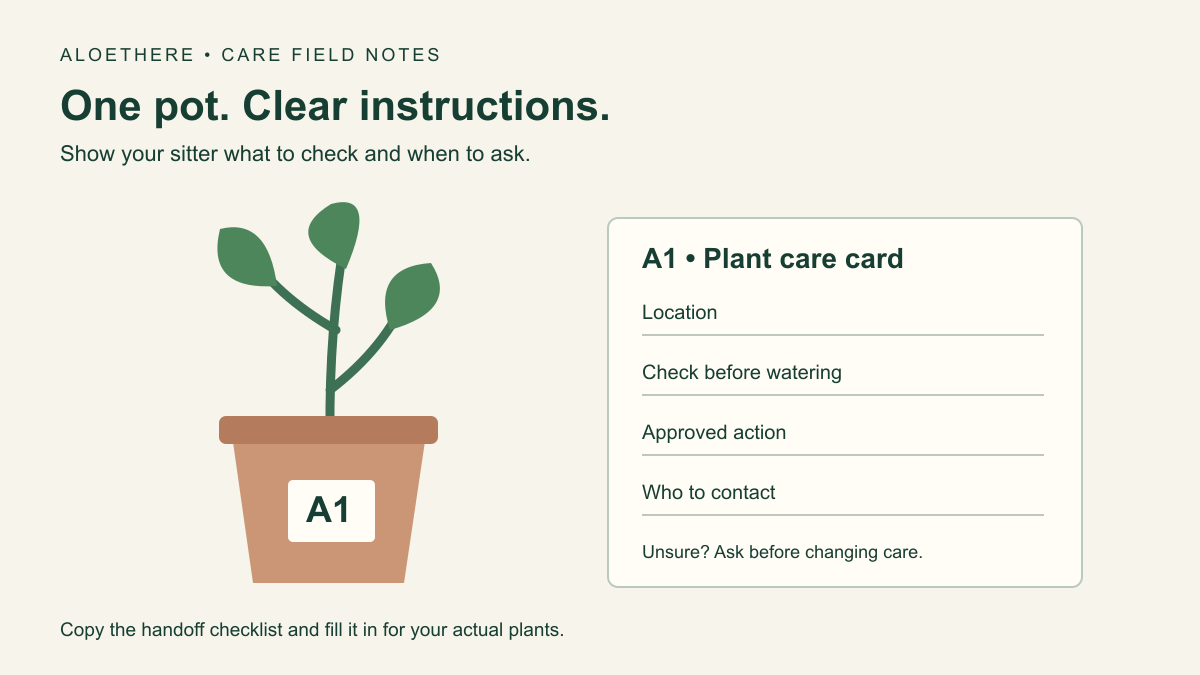
A useful plant-sitter handoff answers four questions: Which plant? What should I check? What am I allowed to do? When should I contact you?
“Water the plants while I'm away” leaves all four open. A short instruction card beside each pot gives your sitter a clearer task without expecting them to diagnose problems or know every species.
Use the checklist below for established houseplants in potting mix. Orchids in specialist setups, newly rooted cuttings, water-grown plants, and self-watering systems need their own demonstrated instructions.
Before you leave: make each plant easy to recognize
Give each pot a label that matches its instruction card: A1, A2, or a familiar nickname. Add its exact location and a recent photo. “A2, the trailing plant on the left kitchen shelf” is more useful than “the pothos” when there are three.
Take your sitter through one complete check. Show where to test moisture, which inner pot lifts out, and how to remove drainage water without lifting a heavy planter. Ask them to talk through the instructions once so you can catch anything unclear.
Record the last watering date and existing damage. A dated photo of an already-brown leaf gives the sitter something to compare with, rather than leaving them to guess whether it happened today.
Agree on visit windows based on what your collection needs, and name a backup person. UF/IFAS includes human check-ins among its vacation-care options. A generic trip length is not enough to choose a watering interval for every pot.
Write a watering decision, not just a watering date
The visit date tells the sitter when to inspect. The instruction card tells them whether to water.
Water needs vary with the plant, environment, and growing medium, so avoid prescribing the same amount or dry-depth rule for every plant. Missouri Botanical Garden explains why indoor plants cannot all be watered by the calendar.
Write the moisture threshold you have established for that particular plant and pot. Demonstrate what it means. If you are unsure of the threshold yourself, check a species-specific horticultural guide or ask a knowledgeable grower before leaving it as an instruction.
For a conventional pot with drainage, a watering instruction can specify thorough watering followed by draining and emptying the saucer, rather than an arbitrary daily splash. That approach is described in Missouri Botanical Garden's watering guidance. Show the sitter how to do it with your actual container.
Our soil-first watering guide provides a longer explanation. The card should contain the few instructions the sitter needs at the pot.
Copy this plant-sitter handoff
Complete the shared information once and make one plant card for each pot. Mark unused fields “not applicable.” Do not leave watering criteria or drainage instructions blank.
Open the plain-text handoff template to save or copy it into your own document. Fill it in privately; this website does not collect the completed checklist.
HOUSEPLANT HANDOFF, SHARED INFORMATION
Away dates:
Agreed visit dates / windows:
Owner contact and likely response window:
Backup contact if the owner cannot respond:
Where supplies are kept:
Curtain / blind position to leave unchanged:
Grow-light or other equipment settings to leave unchanged:
Plants that need special handling:
How to send visit updates:
PER-PLANT CARD
Plant label / nickname:
Plant name, if known:
Room and exact location:
Reference photo and date:
Growing setup (ordinary pot, reservoir, other):
LAST KNOWN CONDITION
Last watered:
Recent repotting, pruning, or treatment:
Existing marks / damage to compare with the photo:
CHECK BEFORE WATERING
Where and how to check moisture:
Water only when these observable conditions are met:
Do not water when:
Next check if watering is not needed:
APPROVED WATERING METHOD
Water source / labelled supply to use:
How to apply water and when to stop:
How to let the pot drain:
How to empty the saucer or outer pot safely:
For a reservoir system: demonstrated refill instructions:
BOUNDARIES
Other specifically approved tasks:
Do not prune, repot, fertilize, spray, or relocate unless listed above.
Contact the owner or backup if the instructions do not match what you see.
AFTER EACH VISIT
Date / time:
Moisture and visible condition:
Watered / did not water:
Other approved action:
Photo or concern sent:
Next agreed check:
Send entry instructions and access codes privately, separately from any checklist that might be shared publicly.
Make “leave it alone” an explicit instruction
Your sitter should not need to decide whether to cut a stem, change the potting mix, or try a pesticide. Put the boundary in writing: No pruning, repotting, fertilizer, sprays, or location changes unless we have agreed on them.
This is a limit on the sitter's task, not a claim that those jobs are always wrong. For an extended absence or an ongoing treatment, arrange the necessary work with someone able to follow the specific plan.
Leave the usual light setup clear as well. Light, temperature, and water use are connected; University of Georgia Extension discusses those relationships. Do not make the sitter guess whether the curtains or grow lights should change.
Before departure, inspect each plant rather than adding an extra watering “just in case.” Test any new watering setup while you are still home, and make its maintenance a separate part of the handoff.
When something looks wrong
Agree on a simple escalation rule: Take a photo, check the card, and contact the owner or backup before improvising a treatment.
Ask for a whole-plant photo, a close-up of the concern, and an underside or pot view when relevant. Include the date, moisture check, and any action already taken. Our three-photo checklist shows what to capture.
A drooping plant is not automatically thirsty. Iowa State University Extension explains that damaged roots in overwatered soil can also cause wilting. When the mix is damp, do not respond with another watering just because the leaves droop.
For a fallen plant, leak, or broken support, prioritize people and the home. Do not ask a sitter to lift an unsafe load or handle unfamiliar electrical equipment. Use the agreed backup contact when you cannot respond.
Close the handoff when you return
Read the visit log before watering. Check the pots yourself and compare any concerns with the departure photos. If damage has appeared, collect the care history before assuming what caused it or trying several treatments at once.
Keep the useful parts of the handoff for your weekly houseplant-care routine: plant identity, location, last observation, action, and next check.
AloeThere Plant Health can help you organize your own plant profiles, photos, care reminders, and health-check history. Give the sitter this completed checklist separately as a message or paper copy; they do not need an app account to use it. The app is free to download with in-app purchases.
A good handoff is permission to do the agreed care, and permission to ask before doing anything else.