Free shipping on orders over $49
AloeThere
Login
Back to blog

Plant care field guide

September 29, 20267 min readBy AloeThere

Why Do Thrips Keep Coming Back? A Houseplant Inspection and Follow-Up Plan

An organized approach to recurring thrips: confirm the pest, separate affected plants, record damage, and keep inspections distinct from label-directed treatments.

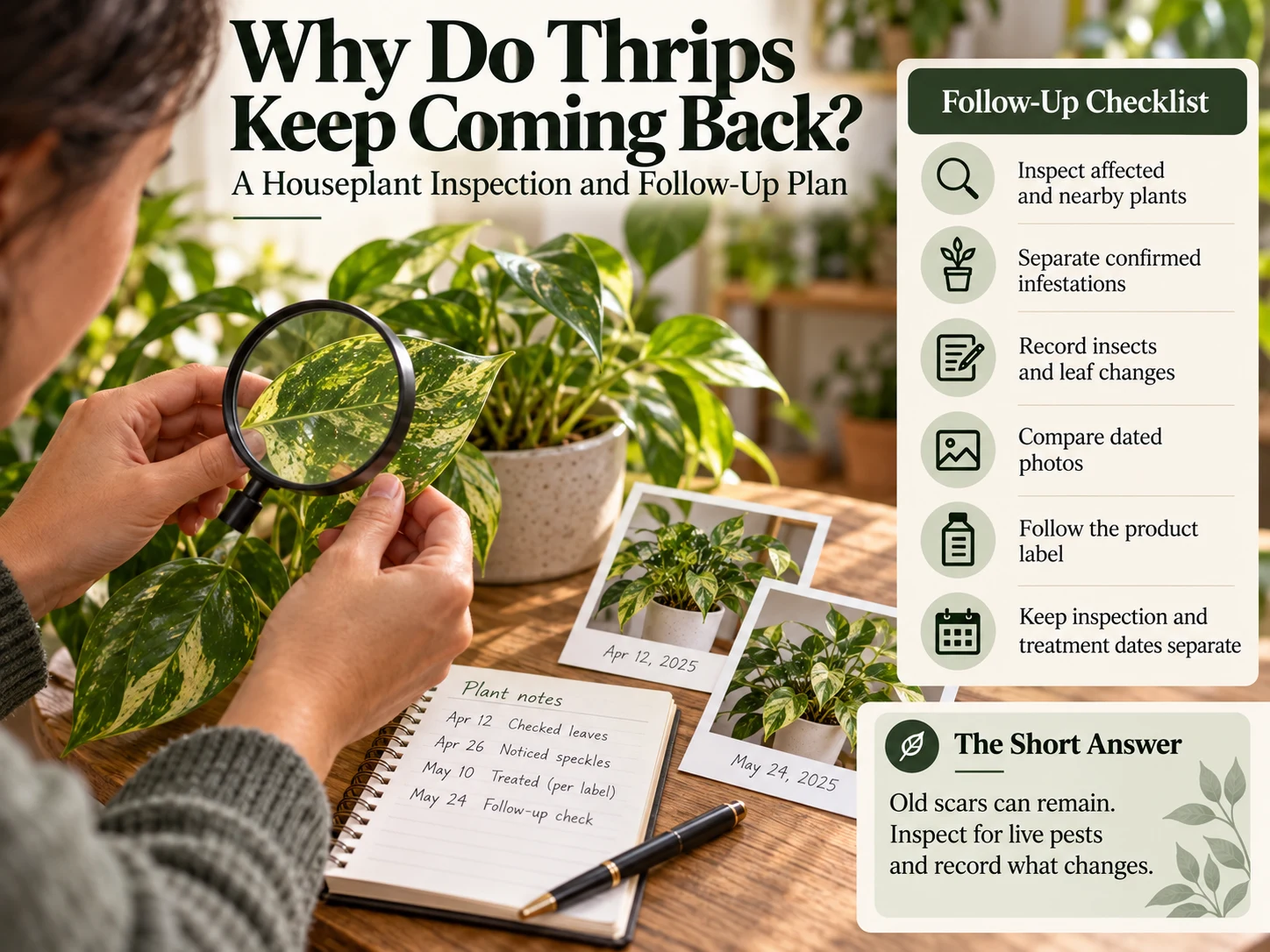
Illustration of a houseplant inspection with a magnifier, dated photos, and a checklist separating inspection from label-directed treatment.

Thrips can appear to return when some survive out of reach, another plant remains infested, or an infestation is reintroduced. There is another possibility: you are seeing lasting damage rather than continuing feeding. Before escalating treatment, establish what you are observing and where. UC Integrated Pest Management explains why protected life stages and damage timing complicate control.

Start with three tasks: inspect the affected plant and its neighbors, separate confirmed infestations, and make a dated record. A follow-up plan should tell you what to check next, not simply remind you to apply another product.
First, distinguish a suspected pest from a confirmed one

Look for the insect itself, not only a damaged leaf. Thrips are small and slender; feeding can leave pale or silvery patches and dark droppings. Other problems can resemble that damage. University of Maryland Extension provides identification images, look-alikes, and places to inspect, including young leaves and sheltered joints. Compare the evidence in its thrips guide.

Use a magnifier where possible. Photograph the whole plant, the affected area, and any insect you can capture clearly. Label an uncertain finding “suspected thrips,” rather than making the treatment record more certain than the evidence. The plant-problem photo checklist helps make those images useful when asking for assistance.

Work out which kind of “coming back” you are seeing

ObservationQuestion to investigateUseful next record
Live insects remain on the same plantWas the identification correct, and did the chosen method reach the affected areas?Where insects were found, plus the exact previous action.
Another plant now has insectsWas it previously exposed or inspected?A simple location map and dated findings for neighboring plants.
Only the same scars remainIs this old damage rather than current activity?A comparison of the same leaf against a baseline photo.
A newly opened leaf has marksCould the injury have occurred before the leaf expanded?The opening date, photographs, and whether live insects are present.
A problem follows a new arrivalCould this be a separate introduction?Arrival dates and inspection records.

These are investigation prompts, not diagnoses. More than one explanation can apply.

Why one visible clean-up may not finish the job

Thrips have several life stages. Eggs can be protected in plant tissue, while pupation sites vary: soil, debris, and parts of the plant can be involved. A treatment aimed at exposed insects therefore does not automatically reach everything. UC IPM describes the life cycle and its variation between species.

That is a reason to continue inspecting. It is not permission to apply products more often, more strongly, or in different ways than their labels allow. Keep the biological explanation separate from the application instructions.

Make separation workable in a crowded collection

University of Minnesota Extension recommends isolating plants when pests are detected. Keep the plant in suitable growing conditions rather than exchanging an infestation problem for a dark, unsuitable holding space. Its indoor-pest guide covers isolation and overall plant care.

For a large collection, use three working labels: confirmed, exposed or uncertain, and no evidence found on the latest inspection. The last category does not mean permanently pest-free.

Write a small map using locations you recognize: “living-room shelf, upper left,” not just plant names that may repeat. Inspect the exposed group as well as the obvious problem plant. Avoid moving pots between groups simply because you need the shelf space; record necessary moves.

Use a clean towel for each plant when wiping foliage. Minnesota specifically recommends changing wiping materials frequently to reduce spread. Keep inspection supplies beside the record so the process is easy to repeat.

For future arrivals, use the new-houseplant first-month guide. An arrival check helps document what came into the collection; it cannot guarantee that a pest was absent.

Compare damage without demanding perfect leaves

Old feeding scars do not disappear after successful control. Damage may also become obvious as previously injured tissue expands. A newly unfurled, marked leaf is therefore not conclusive evidence that today’s treatment failed. UC IPM explains this delay and the limits of treating existing damage.

Choose a few identifiable leaves and photograph them from similar angles. In the notes, separate three observations: live insects, a change since the previous photo, and unchanged old marks. Record “not sure” when a comparison is unclear.

Blue or yellow sticky cards can help detect flying adults, but they are not a complete inspection of the plant. Minnesota includes them as a monitoring tool. Log what you actually find; an empty card is not a clearance certificate.

Choose an action you can follow through on

For manageable infestations, physical removal and selective pruning may be useful. Wiping or rinsing appropriate foliage removes some pests; severely affected parts can sometimes be removed. Avoid turning a gentle clean-up into damage to delicate leaves. Minnesota describes nonchemical options.

If those measures are insufficient, get advice on a product specifically appropriate for the pest, plant, and indoor setting. Insecticidal soaps and horticultural oils are options described by Maryland Extension, but household detergent is not a substitute. Do not combine sprays or improvise recipes. Read Maryland’s chemical-control cautions.

Before any application, check the current container label for the permitted site and plant, target pest, method, rate, repeat interval, application limits, and safety precautions. Follow its directions for protecting people and pets. An outdoor-use product is not automatically suitable for a houseplant kept indoors. EPA explains safe pesticide use.

This article does not prescribe a product or dose. Availability and permitted uses vary by location, so a forum recommendation is not enough to establish suitability.

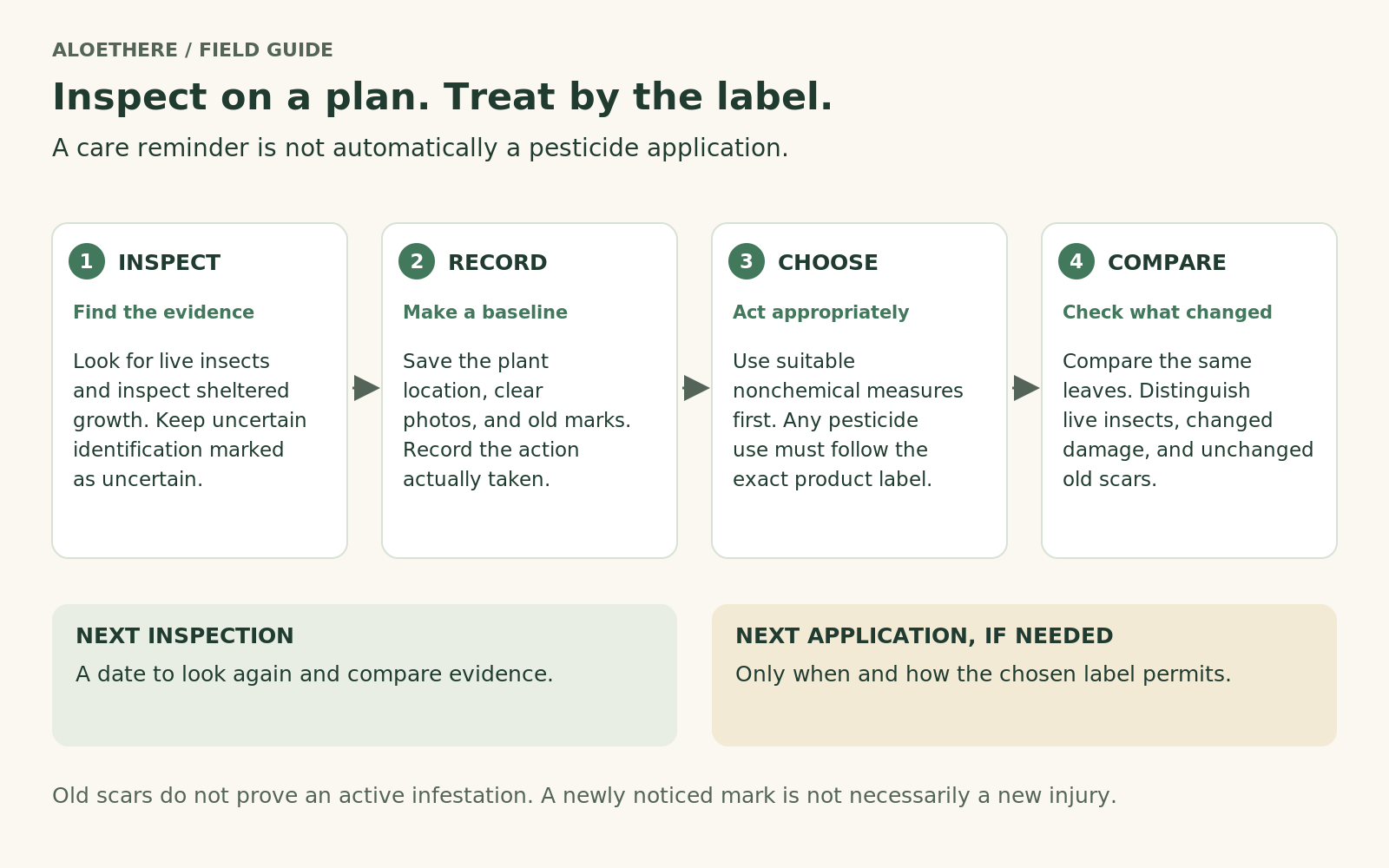
Four-step thrips workflow: inspect, record, choose an action, and compare. Inspection reminders and label-directed applications have separate follow-ups.

View the diagram at full size.

Keep two different follow-up dates

The next inspection date is when you will look again. The next application date, if an application is needed and permitted, comes from the selected product’s label. They are not interchangeable.

Use this original log for each affected plant or clearly identified group:

Date and plant/locationEvidence observedAction actually takenNext inspectionLabel-directed follow-up, if applicable

For a treatment, also save the product name, active ingredient, label, and what was applied. For an inspection without treatment, write “inspected; no application.” Do not leave a blank that makes you wonder later whether you forgot the task.

A reminder might say, “Compare leaf photos and inspect sheltered growth.” It should not say, “Spray every few days,” unless the exact use is supported by the chosen label. Even then, keep the inspection record separate.

Reassess persistent problems before escalating

Bring the log and clear insect photographs to a local extension service or qualified plant-pest adviser. Ask about identification, coverage, the selected method, nearby host plants, and whether the apparent new damage is genuinely new. Resistance is one possible reason control becomes difficult, but the appearance of another insect does not establish it. Maryland discusses resistance among the challenges of thrips management.

Do not double a dose or shorten an interval to compensate for uncertainty. EPA warns that using more pesticide can increase risk rather than solve the problem safely.

Decide what is worth keeping

A badly damaged, heavily infested plant may be more practical to discard than continue treating. Maryland Extension recognizes removal as a reasonable option. That is a management decision, not a judgment about your ability to care for plants.

Consider the ongoing condition of the plant, whether you can maintain separation, and the time and cost of follow-up. There is no universal percentage of damaged leaves that determines the answer. Do not gift or swap a plant you know is infested, and do not assume a cutting taken from it is clean.

The aim is to replace repeated guesswork with evidence: what is present, what changed, what you did, and what you will check next.